Dragons & Mantas - Bali to Komodo Liveaboard
In the grand scheme of things, diving Komodo has tended to be overshadowed by some of its more famous worldly cousins – Raja Ampat, Lembeh Strait, Galápagos and Palau to name but a few. However, my ‘dive radar’ tells me that a changing-of-the-guard is afoot. Although new destinations or itineraries are rare, a few options have recently gained notoriety for their quality, value and accessibility. And Komodo is on this short-list, for sure.
 I have dived Indonesia before but when the opportunity came to dive Komodo, I jumped at the chance as it offers high quality and varied diving that’s very good value. This particular itinerary to Komodo is accessed by sailing from Benoa harbour – just a short drive from Bali international airport, so it makes sense to combine a few nights in Bali before or after your Komodo dive trip.
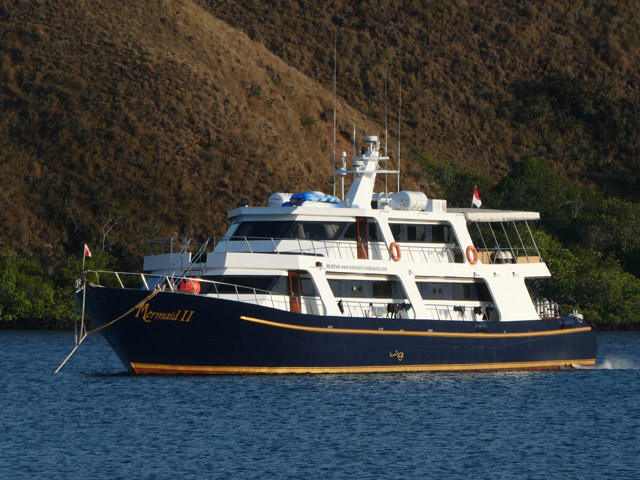
My Komodo liveaboard was Mermaid II and from the moment I stepped aboard, I could tell this was a quality outfit. The crew does the little things well. Some liveaboards can fall foul of thinking size matters, or fine linens doth make a fine week of diving. However, the Mermaid sits in the category of liveaboards that know they have a job to do, and they do it exceedingly well.
Once we were all safely onboard, our wonderful cruise director, Inge, took us through the usual formalities of all liveaboard trips – our cabin allocation, the layout of the dive deck, where to hang and hide our stuff and how to make our time onboard as comfortable as possible. The full-board meal plan is standard (where else would you go?) but the unlimited hot and soft drinks is not so common. Anyone wishing to drink alcohol could help themselves, just as long as it was logged on the honesty chart.
The first and last nights of all Komodo charters are lengthy sea crossings, but no one needed any tablets and, in the main, we all got some sleep. Then from the first morning, it was familiar liveaboard territory of ‘eat, drink, dive, sleep and repeat’.
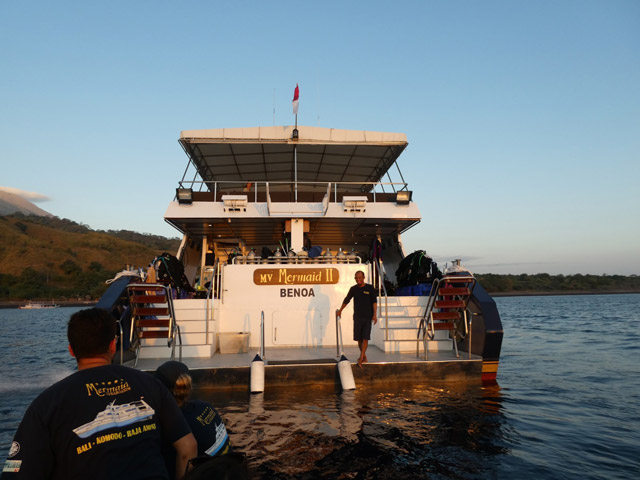
First breakfast (coffee and pastries) is followed by the first dive and, as check-out dives go, this one was an instant winner. It was immediately obvious that the reefs around the northern edges of Lombok, Mojo and Sangeang Islands are pristine. Drifting gently for an hour in 27°C waters, with visibility exceeding 20m, is not exactly tough. Second breakfast was always welcome – a good selection of hot and cold food, washed down by a tasty mug of local coffee tends to set anyone up for the day.
For me, the great thing about diving Komodo was just the variety of dives. No two days were the same and so you never could tell what was around the corner. The excellent dive guides took it in turns to provide strong and detailed briefings, but there was still a chance you might find things that are uncommon in many other dive destinations. Dive sites could be loaded with critters hiding in the black sand one day, or miles of untouched hard corals, bristling with life under the midday sun. Night dives were very popular, offering the chance to find stargazers, minute octopus and frogfish. I searched high and low for a blue ringed octopus, but happily settled for my first bobtail squid and snake eels.
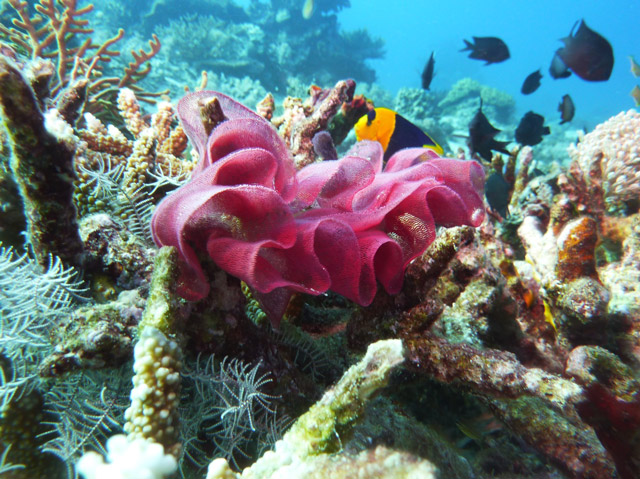
When thinking of diving Indonesia, especially the more remote areas, current is king but this is not a constant factor. The ebb and flow of waters between the Flores Sea to the north and the Indian Ocean to the south keeps these reefs clean and rich in nutrients. Nutrients can sometimes be regarded as a dirty word, as their presence in the water can reduce visibility from pure cobalt blue to murky emerald green in a relatively short period of time. For sure, the visibility throughout the week was variable, but it was rarely less than 20m.
As the liveaboard sails from west to east, the island topography changes. The green land changes to brown and the rolling hills become sharp inclines as the volcanic landscapes begin to dominate.
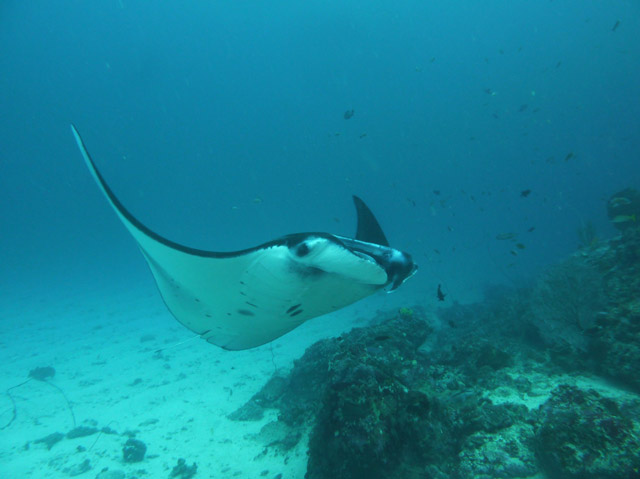
As the trip neared the halfway point, we arrived at the southern tip of Komodo Island itself. Waking up to low, dark clouds, our mooring took on a more sinister feel. What did the day have install for us? Mantas, that’s what. Lots of mantas. Everyone loves a manta. It has to be our most common request from our clients. ‘I want to see mantas (and whale sharks). Where are they guaranteed? When will I see them? I want to see lots ...’ Well, I found them, that’s for sure. The dive site itself is pretty uneventful, but this is common with ‘cleaning stations’. The colourful pretty soft and hard corals gave way to a more edgy rock formation. The currents were picking up and the thermoclines were kicking in. Whereas the day before I had been diving without a wetsuit in 27°C or 28°C waters, today I was pulling on that 5mm wetsuit as we knew the water temperatures were also taking a dive. The surface was still about 26°C but as we dropped to 20m, the current pulled the water temperature down to a low of 22°C.
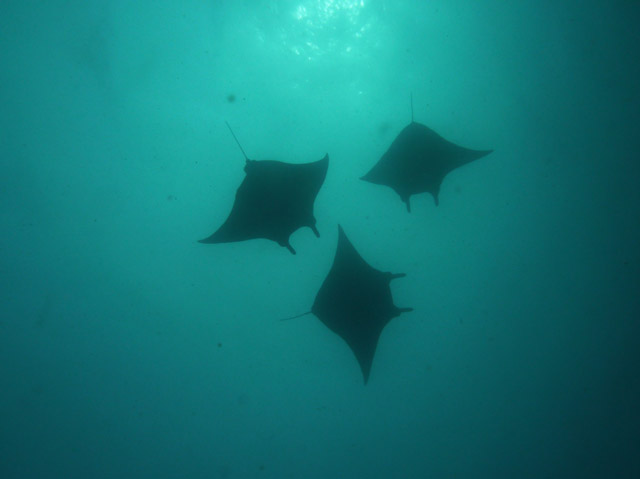
The mantas were there in numbers. Cruising along a shallow wall, they came and soared over our heads, oblivious to our muffled ‘oohs and ahhs’. There is always something magical about diving with mantas and the thing that always gets me is the silence. As you stare straight ahead, lining up the camera to get that magical ‘money shot’, one of them swoops right over the top, so close you could easily touch it. Time and time again, these poets-in-motion would sweep in, playing between the differing water temperature layers. The colder waters brought clarity but the warmer layers brought food – and the latter is a key reason why they come to these small channels. The manta dives mark the turnaround point of the charter. There aren’t too many liveaboards diving these waters but even when we did sit alongside another, we were able to move off to another site to avoid over crowding. Quite a luxury!
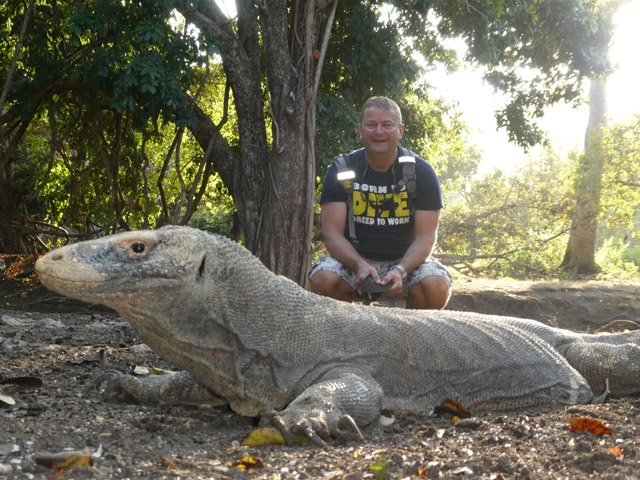
The chance to go ashore on Rinca Island to see the Komodo dragons is a must. These are the largest and heaviest lizards on Earth, with a venomous bite. We approached these oversized lizards with a degree of trepidation but there were no attacks. It was mating season and there were plenty of dragons about – we came across two having a ‘cuddle’ and the guides were so impressed that even they stopped to take photos.
As we headed west on a course back to Bali, we made more dives and another island visit, this time under the shadow of Sangeang volcano. Still very active, it rises almost 2,000m above sea level and, just to remind you it is there, it lets off a puff of ash and smoke every 30 minutes. Diving under an active volcano offers another pretty rare experience – volcanic bubbles popping out of the black sand, rising to the sunshine at the surface. By placing your hand where the rocks meet the sand, you can feel the warmth of naturally superheated water. Flushing your wetsuit puts a smile on your face for sure.
The island also offers the chance to have a wander around the tiny Wera village. Here, local villages are building what appears to be the reincarnation of the Ark. A huge wooden cargo ship is being built right on the beach. Using techniques passed down through the generations, the hard wood structures are being framed by wooden scaffolding, intricately weaved between the local trees. It is very odd, but a fantastic sight to witness.
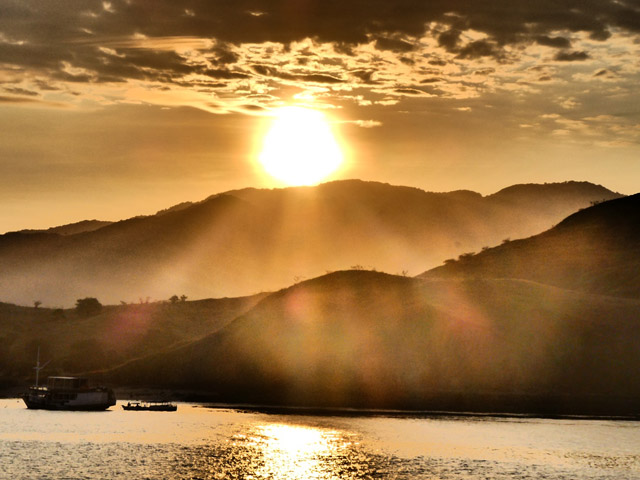
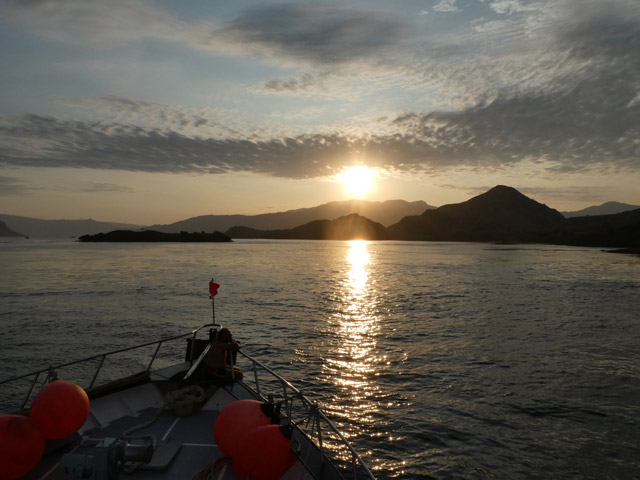
Komodo was truly a great itinerary. Varied and healthy, it was everything I had hoped for and more. It can be dived from both a dive resort or from liveaboards and, I dare say, both will offer sensational sunsets and memories.
Embark on your own Komodo Liveaboard Adventure on the Mermaid II. Speak to the Dive team for more information!