Turtles, Walls and Wrecks in the Cayman Islands - Part 1
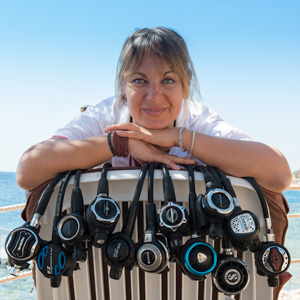
Team member Cath Bates recently returned from exploring the friendly islands and fantastic dive sites of the Cayman Islands.
When Christopher Columbus discovered the Cayman Islands in 1503, he named them Las Tortugas after the many turtles he saw surrounding them. They are classed as one of the world’s most famous diving destinations and the topography and wildlife is diverse across the 3 islands.
The British Overseas Territory sits underneath Cuba and is 180 miles north-west of Jamaica in the Caribbean Sea. The islands are outcrops of the Cayman Trench which is 7,686 meters below sea level! Best diving conditions are November to April when temperatures are cooler.
My trip began with an overnight in Grand Cayman before taking a short domestic flight over to Little Cayman where I spent a few days at the Little Cayman Beach Resort.
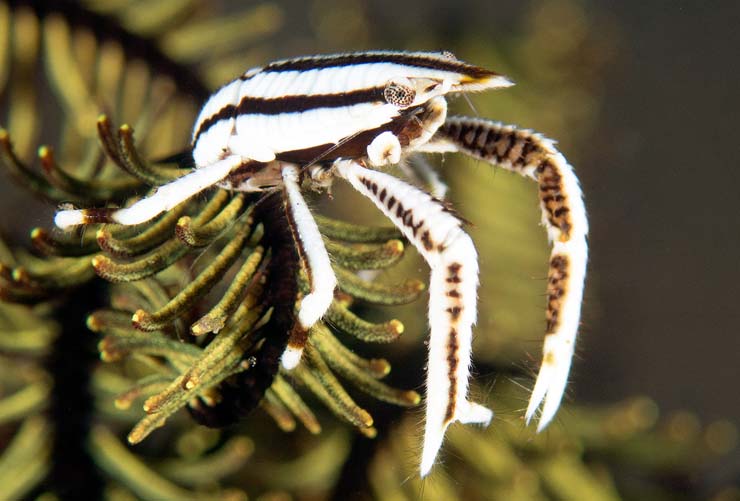 The Clearly Cayman Company has a resort on Grand Cayman, Little Cayman and Cayman Brac and life couldn’t be easier! Their packages vary but basically include everything you could want for a seamless stay with timely transfers, yummy food (lots of it) and diving. Accommodation is spacious and comfortable and you are welcomed into the bosom of the Clearly Cayman family from the moment you step through the door. If you like everything under one roof then this is the package for you (and the rum punch isn’t bad either)!
Little Cayman feels tropical with sandy beaches, hammocks, palm trees lit up with fairy lights and iguanas which are a protected species on the island. Walking down the long wooden jetty to the 42 foot Newton boat called “Holiday Diver”, I was eager to get my head under the bluer than blue water in front of me.
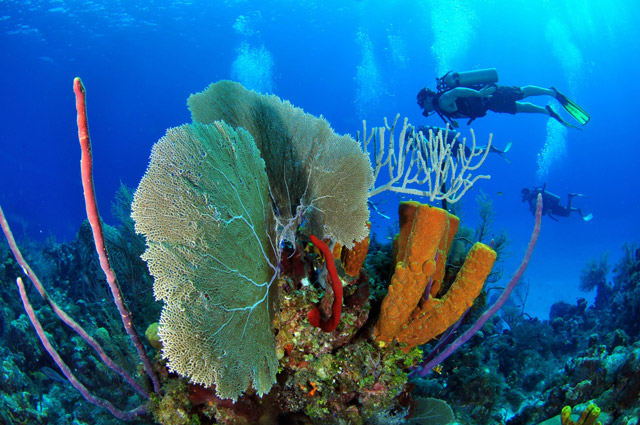 The diving on the south side of Little Cayman is very easy. There is always a bottom underneath you and plenty of tube sponges, sea fans and reef fish to make this a stress-free first days diving. The valet diving makes you feel very pampered and you barely have to lift a finger (well, maybe an arm into your BCD!) However it was the 3 tank safari on day 2 which I was looking forward to.
Bloody Bay Wall is part of the Marine Park Zone and boasts 23 different dive sites with sheer wall dives and canyons as well as coral pinnacles in the shallows. The contrast of technicolour corals and sponges against the background of deep blue is impressive.
As I descended onto Great Wall West I was met by a curious coral grouper who eyeballed my lens suspiciously. Rumour has it they are so used to some permitted divers culling the invasive lionfish that they now follow you, waiting for the possibility of an easy lunch! As I photographed him a hawksbill turtle came down to munch on a tasty bit of coral just next door.
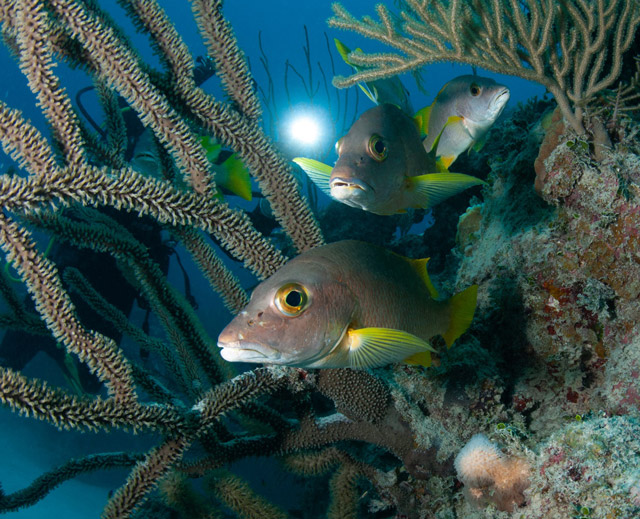 Mixing Bowl treated us to both the wall and a shallower sandy plateau dotted with coral heads. I played hide and seek with barracuda enjoying a cleaning station as well as sweetlips, grunts and chub. As the guide pointed out a snapping shrimp, a nurse shark swam secretively behind us. The groans of half a dozen divers could be heard as we just caught its tail swimming off into the distance!
I enjoyed the enthusiasm of the guides briefings about the local marine life, safety procedures and the organisation of groups underwater; the boats are spacious; the Reef Divers dive centre was also very well stocked with t-shirts and plenty of rinse tanks for gear and cameras.
I was impressed by the green attitude of the resort with compostable cups and other eco initiatives. The island is only 16km by 1km and the staff and locals (of which there are only 170) are very caring about their little taste of Paradise. The Central Caribbean Marine Institute is based on this island and their vision of “a world with vibrant oceans and healthy coral reefs” is inherited by Clearly Cayman.
Keep an eye out for part 2 of Cath’s journey as she heads to Grand Cayman.
Find our more about the Cayman Islands on our website or contact our team to discuss trip ideas.