Palau Spawning Guide
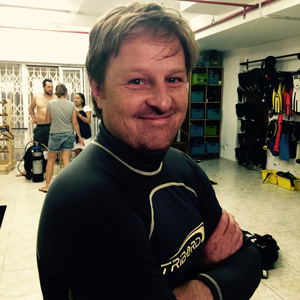
A spawning event is one of the greatest marine spectacles in the world, and arguably nowhere on Earth is better to witness this than in Palau. Here we share more about these special spawning events, which species you can see and when, and how you can join us on a Palau Spawning Expedition led by Richard Barnden, who has over ten years of experience diving into these incredible wildlife phenomena.
There are moments in diving that sit apart from everything else. Not better visibility, or a bigger shark, or a more colourful reef, but something fundamentally different: an encounter so raw and biologically extraordinary that it reframes what being underwater actually means. Witnessing a mass spawning aggregation in Palau is one of those moments.
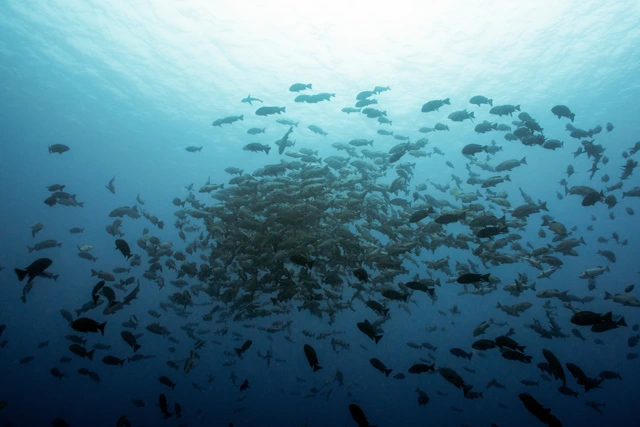 Thousands of fish, driven by lunar rhythms older than human memory, converge at precise locations and precise times to perpetuate their species in a frenzy of colour, sound, and energy. Palau is one of the very few places on Earth where these events unfold reliably, year after year, and where divers with the right timing and the right guide can place themselves in the mix.
What Is a Fish Spawning Aggregation?
A fish spawning aggregation is a gathering of individuals of the same species at a specific site, at a specific time, for the sole purpose of reproduction. Rather than spawning in isolation or in small resident groups, many reef fish species have evolved a strategy of mass participation: concentrating in enormous numbers to release sperm and eggs simultaneously into the water column, maximising fertilisation and overwhelming predators' ability to consume the resulting gametes (sperm and eggs).
The logic is elegant. A single fish spawning alone is highly vulnerable; its eggs represent an easy meal for anything passing by. Ten thousand fish spawning at once produce gametes in such quantity that predators can consume only a fraction, leaving the vast majority to disperse on the currents and develop into larvae. The scale of the event is both its defence mechanism and its spectacle.
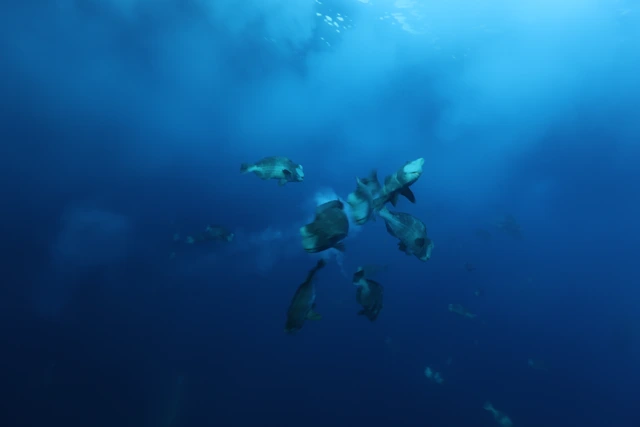 Timing is critical. Most species synchronise their gatherings with the lunar cycle, responding to the gravitational influence of the moon on the tides and to changes in ambient light intensity around the full and new moon phases. The resulting tidal patterns sweep fertilised eggs away from the reef and out into open ocean, reducing predation pressure during the fragile early stages of larval development. Dawn and dusk are the preferred windows within the day: low light limits predator visibility and gives spawning fish an additional margin of safety.
Two broad categories exist. Resident aggregations are formed by fish living close to the spawning site, gathering there on a regular monthly basis. Transient aggregations draw fish from further afield, arriving seasonally, once or twice a year, before dispersing once spawning is complete. Both types occur in Palau, and the distinction matters enormously when planning a visit.
Why Palau?
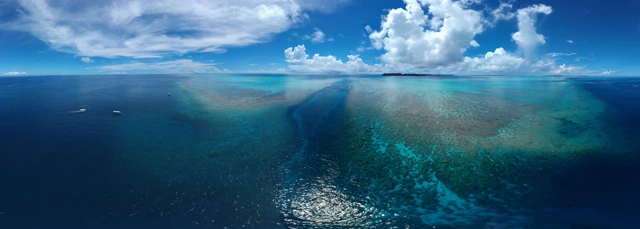
Palau sits at the western edge of Micronesia, at the confluence of three major Pacific ocean currents that deliver nutrient-rich water through the archipelago's channels and passes with remarkable consistency. Those currents serve a dual purpose: they sustain the fish populations large enough to form mass aggregations, and they provide the dispersal mechanism that fish instinctively exploit when selecting spawning sites. The passes and channels of Palau carry fertilised eggs efficiently out to sea, away from reef-based predators. Fish have known this for millions of years.
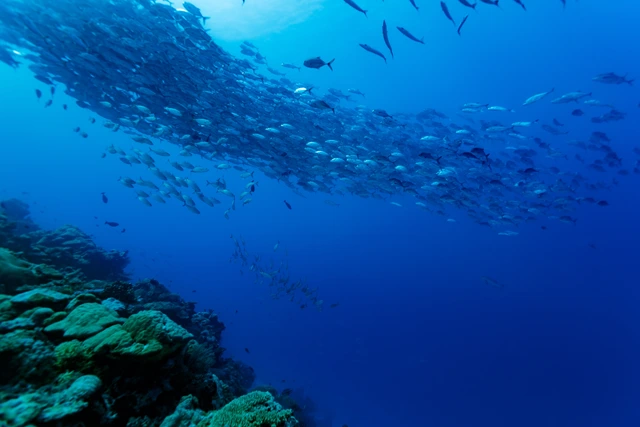 Palau declared the world's first shark sanctuary in 2009, banning commercial shark fishing throughout its waters, and established the Palau National Marine Sanctuary in 2015, protecting 80 per cent of its Exclusive Economic Zone from all extractive activity. The result is a reef ecosystem where fish populations have reached the densities required to sustain mass aggregation events. An overfished reef cannot produce a spawning aggregation of thousands of animals. Palau's reefs can, and do.
Decades of dedicated fieldwork by specialist Palauan dive operators, most notably Paul Collins and underwater photographer Richard Barnden, have mapped the precise timing, location, and behaviour of each species' aggregation through years of painstaking observation. The ability to predict these events reliably enough to plan dive trips around them is the direct product of that work. Without it, the aggregations would continue; divers simply would not find them.
The Species of Palau's Spawning Events
Bohar Snapper (Twin-Spot Red Snapper) (Lutjanus bohar)
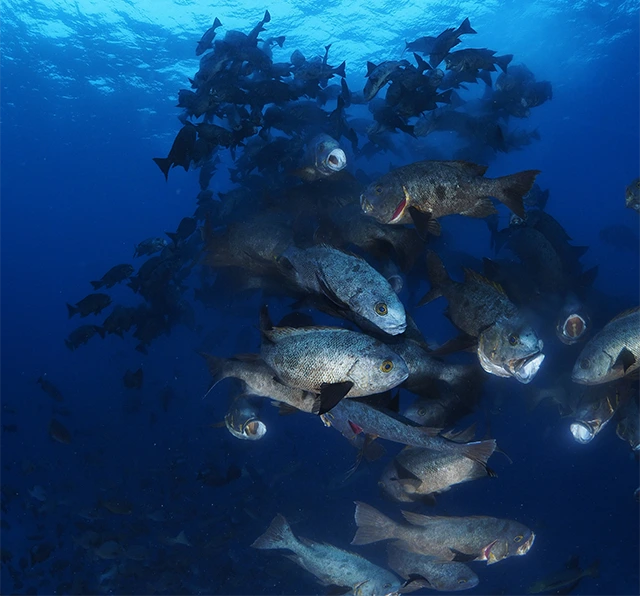 Lunar timing: Full moon — monthly
Time of day: Dawn — open water dives at first light
Aggregation size: 5,000 to 10,000 individuals
Category: Resident aggregation
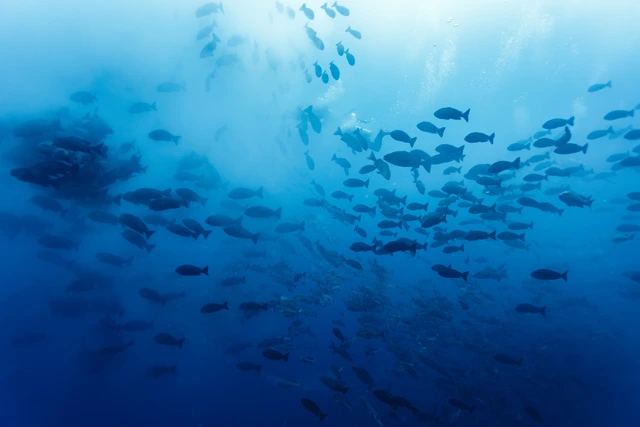
Known variously as the two-spot snapper, twin-spot snapper, or red snapper, the bohar snapper is a large, powerfully built reef predator common throughout the Indo-Pacific, encountered in small groups around reef edges and current-swept promontories. In Palau, it transforms. Around each full moon, thousands gather in what's one of the most reliable and most spectacular fish spawning events available to scuba divers anywhere in the world.
The aggregation forms in open water before dawn. As the tide begins to shift at first light, the school rises from the reef and bursts upward into the blue water column, the fish releasing dense clouds of white gametes in swirling formations that create the impression of an underwater snowstorm. The spawning run is frenzied and fast: the school surges repeatedly from reef to open water and back, spawning as it goes, in a cycle that continues for up to an hour before the fish disperse. Five to ten thousand large, crimson fish moving in a dense mass, surrounded by white clouds of eggs and sperm, with the circling shapes of bull sharks and blacktips visible in the blue beyond. Nothing adequately prepares a diver for the experience.
The bohar snapper reaches 60 to 70 centimetres and several kilogrammes, its deep brick-red colouring and heavy, blunt-nosed build giving the aggregating school a visual weight that amplifies the impact considerably. The sheer momentum of thousands of large fish moving in coordinated formation creates a physical presence that's felt as much as seen.
Bumphead Parrotfish (Bolbometopon muricatum)
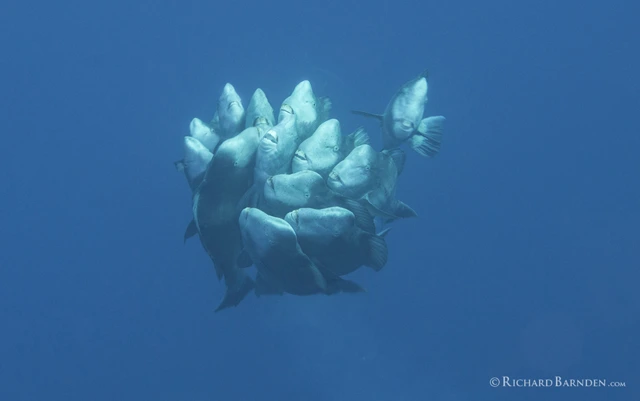 Lunar timing: New moon — monthly (peak aggregations February to May)
Time of day: Dawn
Aggregation size: Hundreds to over 1,000 individuals
Category: Resident aggregation
The largest parrotfish species in the world, bumpheads are one of the most physically imposing animals on the coral reef. They can reach over a metre in length and 46 kilogrammes in weight, the bony forehead protrusion that gives the species its name combines with a deep blue-green colouring to create an animal of considerable grandeur. Schools of bumphead parrotfish are a characteristic sight on healthy Palauan reefs; the sound of their powerful beaks biting into coral, a distinctive crunching audible from many metres away, announces their presence long before they come into view.
Palau is home to what is believed to be the largest bumphead parrotfish aggregation on the planet. Monthly around each new moon, hundreds of individuals converge at specific reef passages in the early morning hours. During the peak months of February through May, more than a thousand can gather. The aggregating fish spill from the lagoon into open water in a formation experienced local guides describe as a waterfall: a dense, flowing column of large fish tumbling over the reef edge and into the blue.
As the aggregation intensifies, males identifiable by their pale foreheads compete aggressively for spawning opportunities, headbutting one another with a sound like distant thunder. This auditory dimension is one of the most consistently cited and least expected elements of the experience: the deep, resonant cracking of large animals colliding, heard through the water as the school surrounds the dive group. Multiple males pursue a single female, the chase escalating until a successful dominant male rises with her into the water column, both fish releasing sperm and eggs in a burst of white cloud before dropping back to the reef. The event lasts approximately an hour. Timing and positioning are everything.
Sailfin Snapper (Blue-Lined Sea Bream) (Symphorichthys spilurus)
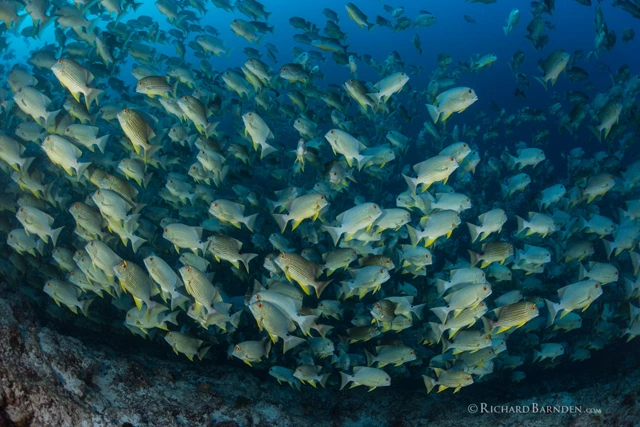 Lunar timing: New moon — twice annually (typically March to May)
Time of day: Dawn / early morning
Aggregation size: Up to 50,000 individuals
Category: Transient aggregation
Known as both the sailfin snapper and the blue-lined sea bream, this is a strikingly coloured fish: silvery body, vivid blue horizontal stripes, a yellow tail distinctive enough to identify at distance. Normally encountered individually or in small groups on healthy reefs throughout the western Pacific, the species gathers twice each year in Palau in one of the archipelago's most visually spectacular spawning events.
The numbers are staggering. Up to 50,000 individuals have been recorded in a single aggregation, making the sailfin snapper gathering one of the largest documented spawning events in Palau. The massed fish pack into a tight ball, a defensive response to the bull sharks, lemon sharks, and blacktips that patrol the edges of the aggregation. Within that ball, the gathering fish create a shimmering, densely packed cloud of blue and silver that swirls in the current above the reef, the intensity of the colouring making for one of the most photogenic of all Palauan spawning events.
Like the camouflage grouper, the sailfin snapper aggregation is a transient event with a brief annual window. The aggregating fish choose specific reef passages where current conditions channel the outgoing tide to disperse fertilised eggs optimally. The precision of that site selection, repeated across years and generations, is a reminder of how much intelligence is encoded in fish behaviour that appears, from the surface, entirely instinctive.
Camouflage Grouper (Epinephelus polyphekadion)
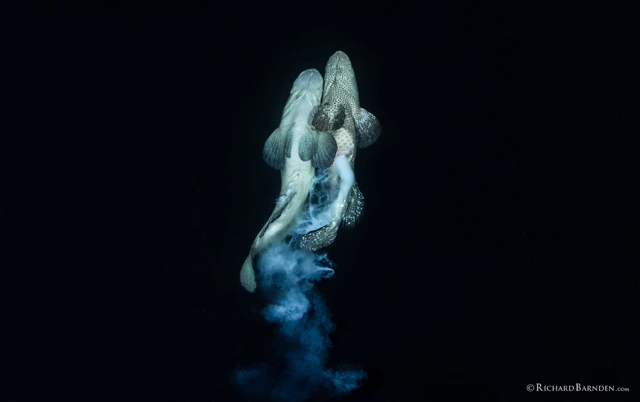 Lunar timing: New moon — twice annually (June and July)
Time of day: Dusk and night dives
Aggregation size: Hundreds of individuals
Category: Transient aggregation
This is the rarest and most exclusive of Palau's regularly observed spawning events, occurring just twice each year, in June and July, at specific reef passages where conditions meet the species' requirements. Unlike the bohar snapper and bumphead parrotfish, which are locally resident fish gathering monthly, the camouflage grouper draws individuals from a wider area on a seasonal basis. Locating and predicting this aggregation took years of fieldwork; only a handful of specialist operators in Palau understand it well enough to offer it reliably.
A medium-sized grouper, typically 50 to 60 centimetres, with mottled brown and white patterning that makes it unremarkable on the reef at rest. At dusk around the relevant new moon, hundreds of individuals converge in a reef passage and begin rising from their positions in a display of escalating activity that builds through the evening into a full spawning frenzy in the dark. Males pursue females aggressively through the water column, emerging in pairs before releasing gametes and dropping back to the reef. Grey reef sharks and lemon sharks patrol throughout, targeting distracted fish. The whole spectacle plays out in torch beams against black water.
Two windows per year. For divers able to plan around them, it's amongst the most sought-after experiences in the diving world.
Moorish Idol & Orange-Spine Unicornfish (Zanclus cornutus / Naso lituratus)
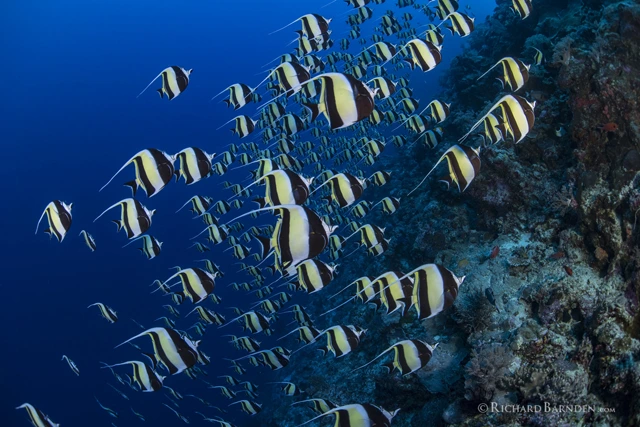 Lunar timing: Full moon — January and February
Time of day: Dawn
Category: Seasonal resident aggregation
Two of the reef's most visually arresting species gather on Palau's outer reefs during January and February in a combined spawning event that's among the more unusual and least-documented of the archipelago's aggregations. The Moorish idol, with its dramatically elongated dorsal fin filament and bold black, white, and yellow banding, is one of the most instantly recognisable fish in the ocean; the orange-spine unicornfish, with its distinctive forward-projecting nasal protrusion and vivid orange spine plates at the base of the tail, is equally striking. Both are normally solitary or found in small groups. Seeing either in a large aggregation is already remarkable. Seeing them together is something else entirely.
These aggregations form around the half moon and build through to the full moon, assembling at dawn on the outer reefs. The exact location and timing are harder to predict than the monthly bohar snapper or bumphead parrotfish events, and not all operators offer these dives; those with the deepest knowledge of the lunar calendar and Palau's outer reef topography give their guests the best chance of finding them. When conditions align, the combined visual impact of the two species moving in formation in early morning light creates a spawning dive of quite distinctive and otherworldly beauty.
The Predators
A spawning aggregation draws in the full cast of the Palauan marine community. The presence of large active predators at spawning sites is not incidental; it's the ecosystem responding to one of its most concentrated and predictable food events, and it's one of the most compelling elements of the experience for divers.
Bull sharks are the most dramatic presence at the bohar snapper aggregation. Large individuals, several commonly exceeding two metres, patrol the perimeter of the spawning school and make targeted strikes into the mass of distracted fish. Their heavy, purposeful movement through the open water alongside thousands of frantic snapper creates a scene of raw predatory theatre that stays with divers long after the dive ends.
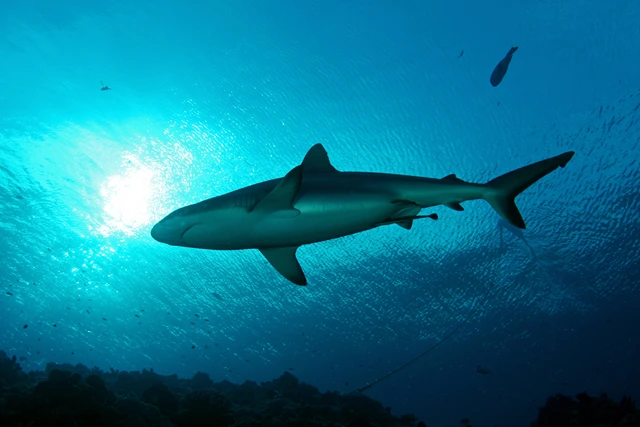
Oceanic blacktip sharks attend the snapper aggregation in numbers, their slender build and speed allowing them to pursue individual fish into the water column in a way the heavier bull sharks cannot. Grey reef sharks, one of the most abundant species in Palau, are present at both the snapper and bumphead parrotfish aggregations. Lemon sharks patrol the camouflage grouper spawning. Whitetip reef sharks can gather too. Each species exploits the event in a manner suited to its own hunting style, creating a study in predator diversity that's as compelling as the spawning aggregation itself.
 Many fish species are also often present. Large Napoleon wrasse circle the periphery of aggregating schools; jacks, barracuda, and large grouper attend. Above the surface, frigatebirds gather to intercept gametes and larval fish reaching the surface film. The aggregation creates a temporary concentration of biological energy that resonates through every level of the food chain simultaneously. Divers are positioned inside it, observing it all at once.
Why Palau's Protection Matters
The spawning aggregations that make Palau so extraordinary exist because of deliberate, sustained, and enforceable conservation policy. Spawning aggregations are amongst the most vulnerable marine events to human disturbance. The history of reef fisheries worldwide is littered with examples of aggregation sites discovered, heavily fished during spawning events, and permanently destroyed within a few years. A fish aggregating in the thousands to spawn is, from a fishing perspective, an almost irresistible target. Fish biomass on Palauan reefs is measurably, dramatically higher than on comparable unprotected Indo-Pacific reefs thanks to the protections put in place. Every spawning event described in this guide depends on that abundance directly.
 The science supports the mentality which responsible operators have long practised. Research published in a marine policy journal concluded that dive ecotourism at fish spawning aggregation sites represents an economically attractive and significantly less exploitative alternative to commercial fishing, providing concrete financial incentives for the protection of the very events it depends on. In Palau, that principle is embedded in how the best operators work: strict diver limits at each session, typically no more than 24 per event; thorough pre-dive briefings covering conduct in the water; no flash photography during the most sensitive phases; and a genuine understanding, built over years of working with these animals, that the aggregations are a biological treasure requiring active stewardship.
The Diver Experience
Planning a Palau spawning trip is different from booking a conventional diving holiday. Dates must align with the relevant lunar phase, and some events are highly seasonal, which means the lunar calendar drives the itinerary rather than the other way around. Specialist operators track the moon cycle, tidal patterns, and water conditions continuously in the days before each event, refining predictions of exact timing and location as conditions develop.
Most spawning dives begin in darkness. The boat heading for its destination well before sunrise; the dive site is reached whilst the horizon is still black. There's something particular about arriving above a reef at that hour, the water surface dark and still, with the knowledge that thousands of fish are already assembling below. The transition from the dark surface world into the spectacle unfolding beneath it is a diving experience of quite unique atmosphere.
Video courtesy of Richard Barnden
The bohar snapper dive takes place in open water, at sites east of Koror or around the historic island of Peleliu depending on conditions. Divers descend into the blue at dawn and hold station, waiting. When the aggregation rises, there's no gradual build: thousands of large red fish surge upward simultaneously, releasing white gametes in billowing streams, the whole mass in constant, rapid, churning motion. Bull sharks are visible at the edges. The scale of it is total and immediate.
The bumphead parrotfish spawning dive is shallower and closer to the reef, but its practical demands on divers remain considerable. Currents at spawning sites are powerful and variable; maintaining position whilst the aggregation swirls around and above the dive group requires solid buoyancy control and good air consumption. All those joining a group spawning trip must be experienced divers. Operators require a minimum of 50 to 100 logged dives and the ability to descend quickly and swim against current when needed; advanced certification is strongly recommended. The auditory experience, those deep resonant cracks of males headbutting one another heard from within the school, is something no amount of prior reading prepares a diver for. It has to be heard.
Between spawning dives, Palau's standard sites, Blue Corner, Blue Holes, German Channel, Ulong Channel, Peleliu Wall, and the WWII wrecks of the lagoon, ensure the rest of any itinerary is far from merely adequate. Palau is exceptional on every dive. The spawning aggregations are its peaks.
 Planning Your Palau Spawning Diving Holiday
The bohar snapper and bumphead parrotfish aggregations are monthly resident events, accessible year-round with the right lunar timing; the peak months of February through May deliver the largest bumphead gatherings. The sailfin snapper aggregation typically runs across March, April, and occasionally May. The camouflage grouper aggregation is available only on the June and July new moon windows, making these the most date-specific trips in the Palauan spawning calendar. A combined itinerary in June or July, targeting both bumphead parrotfish and camouflage grouper on the same trip, is one of the most extraordinary double spawning experiences available anywhere in the diving world.
Diving with an operator whose knowledge of these aggregations comes from years of direct observation, not general diving familiarity, is a crucially important factor in the quality of the experience. Not every dive operator in Palau offers spawning dives; those that do vary significantly in the depth of their expertise. Our team has worked with the specialist operators who pioneered this diving and knows who to trust to offer a Palau Spawning Expedition.
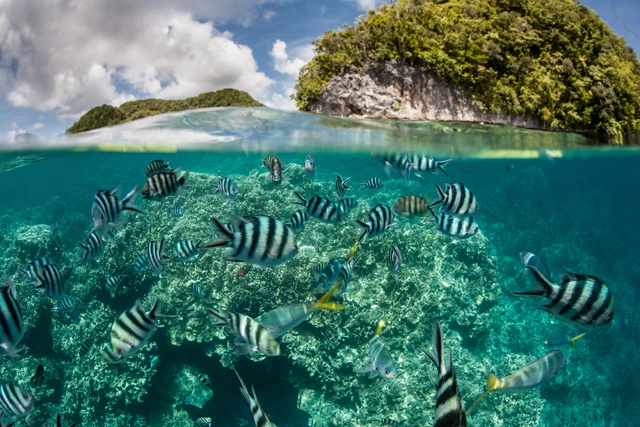 Both liveaboard and land-based options are available. A liveaboard allows the vessel to position precisely at the relevant site and adjust plans in real time as conditions develop. A land-based stay at a specialist resort provides deeper engagement with the destination as a whole. Those choosing a land-based Palau diving holiday need to dive at least one day before being able to participate in a spawning excursion.
Witness the Spectacle for Yourself
A Palau spawning diving holiday is one of the most carefully timed and richly rewarding trips in the diving world. Our friendly Dive team will work with the lunar calendar, the seasonal patterns of each species, your experience level and your travel dates to design an itinerary that gives you the best possible chance of witnessing these extraordinary natural events, alongside the world-class diving that makes Palau exceptional on every single dive.
Speak to our team to join us on a Palau Spawning Expedition led by Richard Barnden.